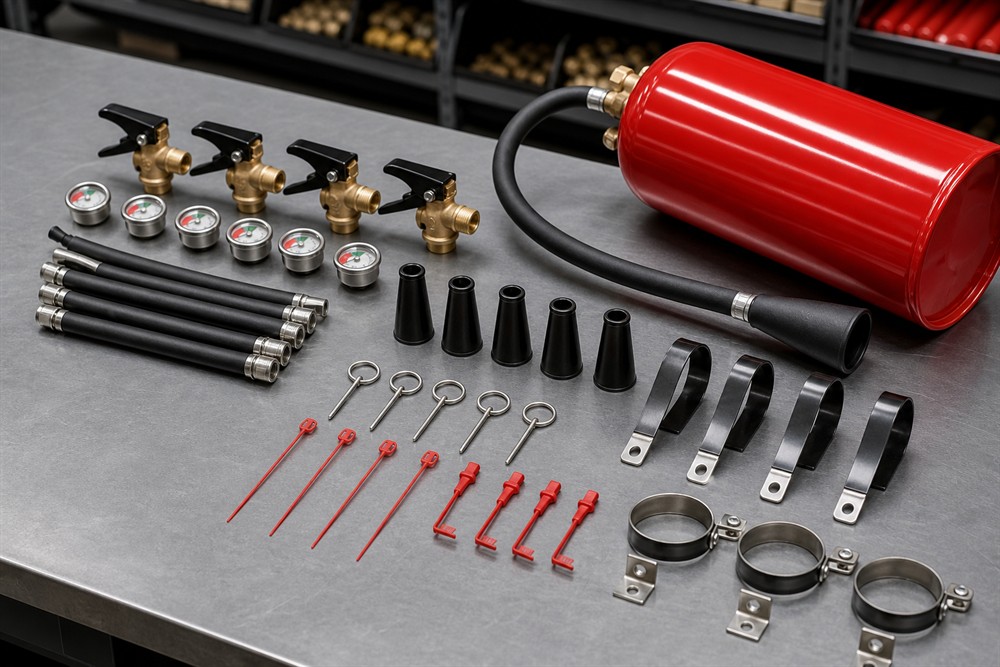
A fire extinguisher is a system of components, not only a cylinder and extinguishing agent. Valves, gauges, hoses, horns, pins, seals, brackets, siphon tubes, O-rings, and fittings influence operation, serviceability, compliance, and long-term customer support.
For distributors and service companies, component planning should begin with the first product order. Waiting until spare parts are needed can create compatibility and lead-time problems.
Valve Assembly
The valve must match the cylinder thread, extinguishing agent, pressure, operating method, and approved product configuration. Material, machining, sealing surfaces, lever geometry, safety devices, and inlet or outlet connections should be controlled.
Procurement checks
- Valve material and surface treatment
- Thread type, size, and gauge-control method
- Working-pressure compatibility
- Safety relief or burst-disc arrangement where applicable
- Handle, lever, pin, seal, and locking geometry
- Approved component reference for certified models
Do not approve a substitute valve based only on external appearance. Internal passages, threads, sealing, spring behavior, and safety features may differ.
Pressure Gauge
Stored-pressure extinguishers rely on a gauge or indicator to show pressure condition. Buyers should specify the connection, scale, operating range, accuracy requirement, leak resistance, case construction, and orientation.
Check that the gauge face remains readable after assembly and labeling. Gauge markings and color zones must match the intended product and market. Sampling and calibration controls should be part of incoming or production inspection.
Hose, Horn, and Nozzle
The discharge assembly affects reach, flow, user control, and agent pattern. Hose length, internal diameter, pressure capability, flexibility, crimping, fittings, storage position, and low-temperature behavior may matter.
CO2 horns require materials and geometry suitable for the cold discharge. Dry powder, foam, water, and wet chemical products use different nozzle arrangements. Confirm that the component is part of the tested or approved configuration.
Safety Pin and Tamper Seal
The pin should prevent accidental operation while remaining practical to remove in an emergency. Diameter, material, ring size, insertion direction, and retention should be consistent. The tamper seal provides visible evidence of use or interference but must not make the pin difficult to pull.
Specify seal color and branding only after confirming that material and break force remain appropriate.
Bracket, Hook, and Cabinet Interface
Wall hooks, vehicle brackets, straps, and cabinet supports must fit the cylinder diameter, body geometry, and installation environment. Vehicle and marine applications may require stronger retention and vibration resistance than a normal indoor wall installation.
Ask for bracket drawings, mounting-hole positions, material thickness, coating, hardware, and packed placement. Test the actual extinguisher in the bracket rather than approving the two items separately.
Internal Parts and Seals
Siphon tubes, O-rings, gaskets, springs, dip-tube retainers, and valve seals are easy to overlook but important for discharge and leak performance. Material compatibility with the extinguishing agent and temperature range is essential.
Service kits should identify every included part and the models with which it is compatible.
Create a Spare-Parts Strategy
Order by installed base
Estimate spares using expected sales volume, service interval, local maintenance practice, warranty experience, and component lead time. Fast-moving items may include pins, seals, hoses, horns, brackets, labels, and gauges, but the correct mix depends on the range.
Control revisions
If the factory changes a valve or component, record the effective production batch and compatibility. Otherwise, visually similar replacement parts may not fit older stock.
RFQ Checklist for Components
- Part number and controlled drawing or specification
- Compatible extinguisher models and production revisions
- Material, finish, dimensions, and performance requirement
- Approval restrictions for certified models
- Unit packing, MOQ, and lead time
- Incoming-inspection method
- Recommended service stock
A disciplined component checklist improves finished-product consistency and makes after-sales support more reliable. It also gives buyers better control when comparing quotations that appear similar at the cylinder level.