Fire extinguisher capacity affects fire rating, discharge duration, handling, placement, maintenance, and logistics. A larger extinguisher is not automatically better, and a compact unit may be inadequate for the identified hazard. Commercial and industrial buyers should select sizes as part of a risk-based system.
Local codes, standards, and qualified fire protection professionals determine the final type, rating, quantity, and placement. Manufacturers support that decision with accurate product data and configuration options.
Begin With the Hazard, Not the Cylinder
Identify the combustible materials, processes, electrical equipment, flammable liquids or gases, cooking oils, vehicle risks, and environmental conditions. The fire class and required rating are more meaningful than nominal kilograms or liters alone.
Two extinguishers with the same agent charge can have different ratings because of agent formulation, discharge performance, hose and nozzle design, and tested configuration.
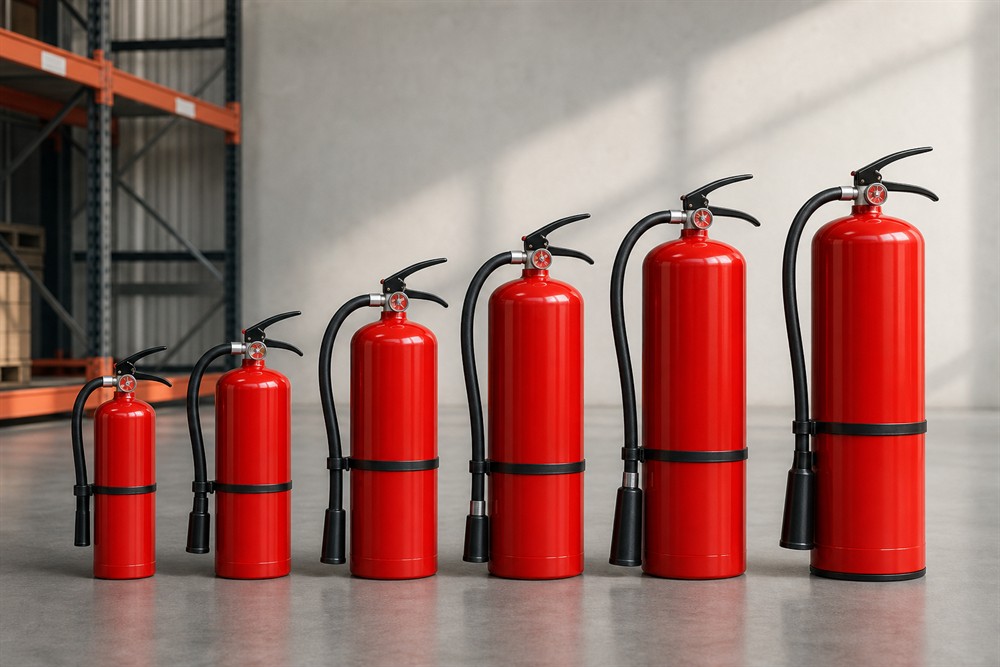
Understand Common Capacity Roles
Compact units
Small extinguishers are easier to handle and install in vehicles, small rooms, equipment enclosures, or supplementary locations. Their reduced discharge quantity and duration mean they must be matched carefully to the expected risk.
General commercial sizes
Mid-range portable units are common in offices, shops, warehouses, apartment common areas, and light industrial facilities. They balance performance, wall mounting, serviceability, and user handling.
Large portable and wheeled units
Higher-capacity portable extinguishers offer more agent but also more weight. Wheeled units can provide substantially greater capacity for high-hazard locations, fuel handling, process areas, utilities, and large industrial sites. Access, hose reach, floor condition, and trained operators become important.
Compare Rated Performance
Ask for the fire rating achieved by the exact model under the applicable test standard. Confirm that the offered agent, cylinder, valve, hose, nozzle, and filling configuration match the tested product.
For project schedules, record both nominal capacity and rating. This prevents substitutions based only on a similar cylinder size.
Consider the User and Installation Location
An extinguisher must be accessible and manageable. Evaluate total filled weight, grip height, hose arrangement, bracket, carrying distance, and the likely user population. In some locations, distributing several manageable units may be more practical than relying on one very heavy portable extinguisher.
Installation conditions include indoor or outdoor exposure, temperature, vibration, corrosion, vehicle movement, wall strength, cabinet dimensions, and route clearance.
Account for Agent-Specific Differences
- Dry powder: broad applications, but residue and visibility must be considered.
- CO2: clean discharge, but cylinders can be heavy and gas can disperse quickly.
- Foam or water-based agents: useful for defined hazards, with temperature and electrical-use limitations depending on the product.
- Wet chemical: designed for cooking-oil and fat hazards when approved for that purpose.
- Clean agents: selected for sensitive environments under the relevant rules and environmental requirements.
Include Logistics in the Size Decision
Capacity influences carton dimensions, gross weight, pallet pattern, container quantity, storage, installer handling, and service inventory. Request net and gross weights, individual and master carton sizes, pallet configuration, and loading quantities before finalizing the commercial comparison.
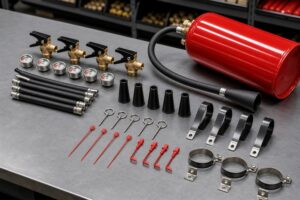
A mixed-size order may improve market coverage but increase component, label, carton, and spare-parts complexity. Standardizing valves, gauges, brackets, or carton footprints where technically permitted can simplify inventory.
Information to Include in a Project Schedule
- Location or zone
- Identified hazard and fire class
- Required standard and rating
- Agent and nominal capacity
- Operating temperature and environmental exposure
- Bracket, cabinet, hose, or trolley requirements
- Quantity, spare units, and service parts
Confirm Before Ordering
Have the local designer, consultant, installer, or authority review the schedule. Then ask the manufacturer to return a model-by-model compliance matrix rather than a general quotation.
Correct sizing connects the protected risk, tested performance, user capability, and local rules. Treating capacity as only a catalog choice can lead to unsuitable equipment and costly project revisions.