The cylinder is the pressure-bearing core of a fire extinguisher. Its quality depends on material control, forming accuracy, welding consistency, surface protection, pressure testing, and traceability. Because defects may not be visible after coating and assembly, quality must be built into every production stage.
Importers should understand these stages well enough to ask useful questions and define inspection evidence in the purchase specification.
Incoming Steel and Material Identification
Quality control starts before forming. The factory should verify material grade, thickness, supplier documentation, batch identity, and surface condition. Material records should be linked to production lots so a later investigation can trace finished cylinders back to the relevant input batch.
Storage also matters. Rust, contamination, mixing of grades, or uncontrolled offcuts can create problems before manufacturing begins.
Forming the Cylinder Body
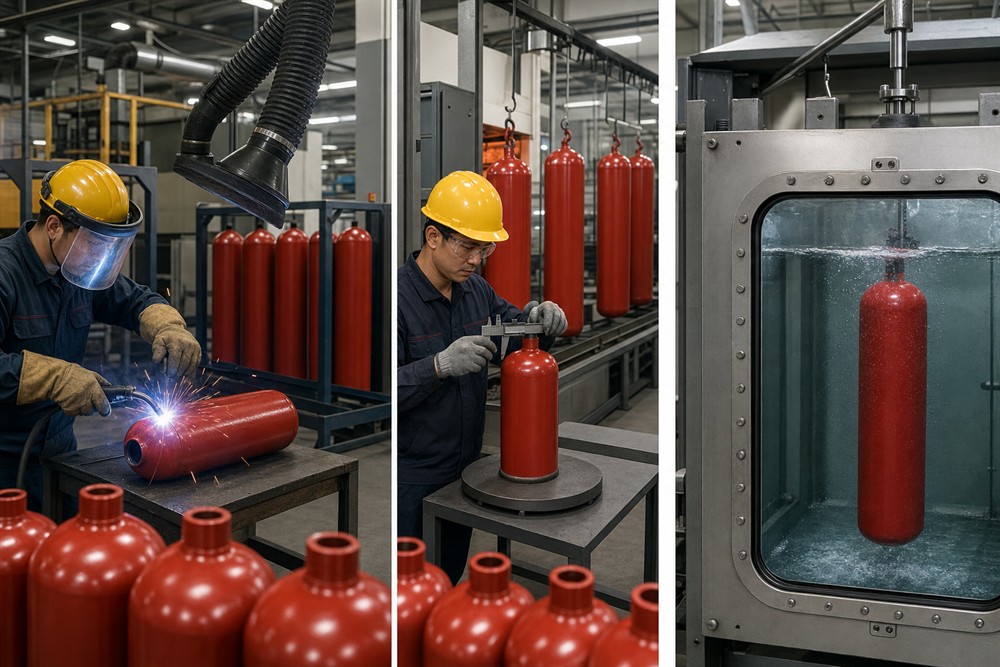
Depending on the cylinder design, steel may be deep drawn, rolled, spun, or formed through other approved processes. Operators control diameter, wall distribution, neck geometry, roundness, and overall length. Tool wear and setup variation can affect dimensions, so in-process measurement is necessary.
Critical dimensions should have defined tolerances and a measurement frequency based on the process and production volume.
Welding and Joint Inspection
For welded cylinders, joint preparation, fit-up, welding parameters, equipment condition, and operator qualification influence integrity. The factory should control current, speed, shielding where applicable, and alignment. Weld appearance alone is not sufficient, but visual inspection can identify undercut, porosity, incomplete seams, distortion, or contamination.
Questions buyers can ask
- Which welding process is used for this model?
- How are parameters set and recorded?
- How often are destructive or macro tests performed?
- How are weld defects classified and handled?
- How is the cylinder lot linked to welding records?
Heat Treatment and Cleaning Where Applicable
Some cylinder constructions or specifications require heat treatment. Where applicable, time, temperature, loading pattern, furnace uniformity, and calibration must be controlled. Records should identify the batch and cycle.
Before coating, cylinders require cleaning and surface preparation. Oil, scale, rust, or residue can weaken coating adhesion and create corrosion sites.
Hydrostatic or Pressure Testing
Pressure testing verifies the cylinder’s ability to withstand the specified test condition. The test pressure, hold time, medium, equipment calibration, acceptance criteria, and test frequency must match the applicable design and standard.
A safe test station protects personnel and controls water, pressure, and cylinder restraint. Test records should identify the date, batch, equipment, result, and responsible operator or inspector.
Do not confuse different tests
Cylinder pressure testing, assembled-extinguisher leak testing, and discharge-performance testing have different purposes. A strong control plan uses the required tests at the appropriate production stage rather than treating one as a substitute for all others.
Surface Coating and Corrosion Protection
After surface preparation, coating quality depends on film thickness, cure conditions, coverage, color consistency, adhesion, and handling. Buyers should define the expected finish and any market-specific corrosion or environmental performance.
Inspect difficult areas such as the base, neck, weld region, and support contacts. Packaging should prevent abrasion after the coating has passed inspection.
Final Dimensional and Visual Inspection
Before assembly, confirm thread condition, neck alignment, base stability, internal cleanliness, dimensions, finish, and permanent markings. Thread gauges and calibrated measuring tools should be available for controlled characteristics.
Traceability Makes Quality Evidence Useful
Batch or serial identification should connect the finished extinguisher to cylinder production, pressure testing, filling, assembly, and final inspection. Traceability allows the factory and buyer to isolate affected stock if a problem is discovered.
What to Include in a Buyer’s Inspection Plan
- Material and batch documentation review
- Critical cylinder dimensions and weight
- Weld and surface visual inspection
- Pressure-test record verification
- Coating appearance and thickness checks where specified
- Thread, neck, and base condition
- Lot marking and record traceability
Cylinder quality cannot be confirmed by checking finished red paint alone. Buyers gain better control when they review the process, records, and traceability behind the finished product.