OEM manufacturing allows fire equipment distributors to build a product range suited to their market, brand, and channel. The opportunity goes beyond adding a logo to a standard red cylinder. A successful program aligns technical configuration, compliance, artwork, packaging, inspection, spare parts, and order planning.
The safest approach is to separate cosmetic choices from controlled product characteristics and approve both through a documented process.
Define the Technical Platform First
Begin with the destination market, intended application, applicable standard, extinguishing agent, nominal charge, fire rating, operating temperature, and cylinder construction. These decisions establish the technical platform on which branding and commercial options can be added.
Do not assume that a preferred valve, pressure gauge, hose, bracket, or cylinder finish can be exchanged freely. For approved models, critical components may be controlled by the certification or listing file.
Common OEM Customization Options
Product configuration
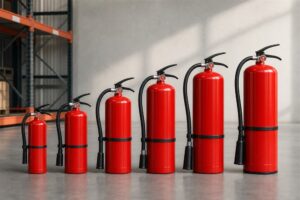
- Capacity and extinguishing-agent type
- Stored-pressure or cartridge-operated arrangement
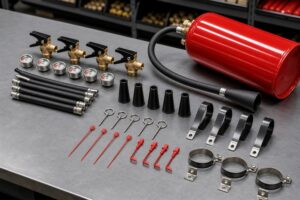
- Valve, gauge, hose, horn, bracket, and safety-pin options
- Cylinder finish and permitted color selections
- Operating instructions and language set
- Individual carton, master carton, pallet, and accessory kit
Brand presentation
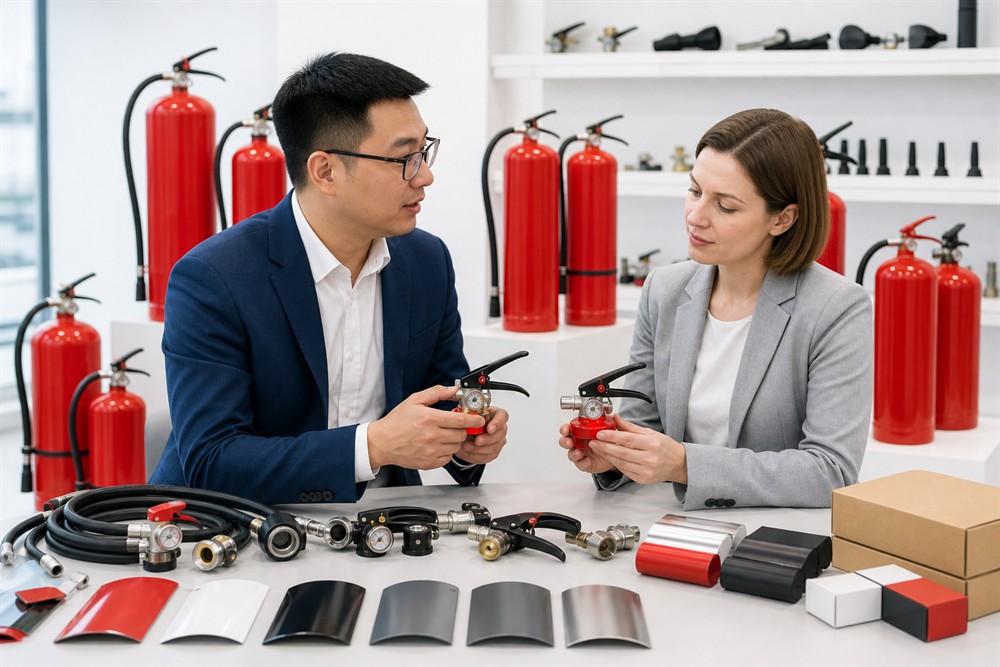
Private-label elements may include the main label, instruction panel, neck ring, tamper seal, carton printing, manual, barcode, importer details, and warranty information. Artwork should reserve the required space for mandatory markings and should never introduce an approval mark that the exact product is not entitled to carry.
Create One Controlled Product Specification
A complete specification reduces misunderstandings between purchasing, sales, engineering, production, and quality teams. It should record dimensions, materials, agent, filling tolerance, working and test pressures, component models, finish, markings, accessories, packing, inspection criteria, and approved artwork revisions.
Use a revision number and date. When one item changes, issue an updated version rather than relying on an email thread or marked-up photograph.
Approve Samples in Stages
Engineering sample
The engineering sample confirms the technical configuration. Inspect dimensions, weight, valve assembly, gauge, hose or horn, bracket, finish, safety devices, and discharge arrangement. Match it against the model documentation and specification.
Artwork and packaging proof
Review label scale, readability, color, language, symbols, model information, importer details, barcode quality, carton strength, internal protection, and packing orientation. A digital proof is useful, but a physical pre-production sample can reveal adhesion, curvature, color, and carton-fit issues.
Pre-production sample
Before mass production, approve a sample made with the intended components, finish, label, and packaging. Keep one signed golden sample with the buyer or inspection company and one at the factory.
Plan MOQ Around Real Production Constraints
Minimum order quantities may be driven by cylinder production runs, powder or chemical batches, custom labels, printed cartons, special valves, and certification restrictions. Ask the manufacturer to separate the MOQ for the technical model from the MOQ for customized materials.
Distributors can often reduce inventory risk by using a common approved product platform across several label or carton variants, provided traceability and production controls remain clear.
Protect the Program With Change Control
Set a rule that no controlled component, material, supplier, process, label, or packaging change is implemented without documented review. The factory should identify the reason, impact, affected orders, certification implications, sample requirement, and effective date.
This is especially important when component availability changes or cost pressure encourages substitutions.
Include Spare Parts and After-Sales Support
A distributor program should plan beyond the first shipment. Confirm compatible valves, gauges, hoses, horns, pins, seals, brackets, labels, and service information. Determine which parts may be replaced locally and which operations must follow local service regulations.
OEM Project Checklist
- Approved technical model and destination-market route
- Signed specification and bill of materials
- Controlled label, manual, and carton artwork
- Golden sample and inspection checklist
- MOQ, lead time, and material-reservation plan
- Change-control and nonconformity process
- Spare-parts and repeat-order strategy
OEM fire extinguisher manufacturing works best as a controlled product-development project. Clear responsibilities and documented approvals give the distributor brand flexibility without weakening compliance or repeatability.