A private-label fire extinguisher line can strengthen a distributor’s market position, but the brand owner also becomes responsible for product information, consistency, and customer expectations. A compliant program requires more than sending a logo file to a factory.
The strongest projects use one controlled workflow from market definition through repeat production.
Define the Market and Compliance Route
Identify the destination country, sales channel, customer type, installation environment, product standard, approval route, languages, importer information, and after-sales model. These decisions determine which technical platforms and markings can be considered.
Do not design the label before confirming the exact approved model. Mandatory information, warnings, symbols, approval marks, and responsible-party details may occupy significant space.
Select a Controlled Product Platform
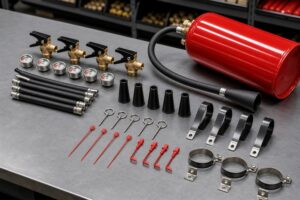
Define agent, capacity, fire rating, cylinder, valve, pressure gauge, hose or horn, bracket, operating temperature, finish, and accessories. Match every major component to the model documentation.
A family approach can simplify a private-label range. For example, several capacities may share a common visual language and selected components while retaining model-specific ratings, instructions, and controlled parts.
Build an Artwork Information Hierarchy
Mandatory product information
Reserve space for the information required by the applicable standard and destination rules. This may include model identification, agent, charge, rating, operating instructions, warnings, temperature range, pressure information, manufacturer or responsible-party details, traceability, and approval markings where legitimately applicable.
Brand and commercial information
Add the brand, product family, contact channel, barcode, warranty reference, and distributor information without reducing the readability of safety instructions. Use controlled source files and outline or package fonts correctly for production.
Control Claims and Approval Marks
Never treat certification marks as decorative options. Verify that the exact model, manufacturing site, certificate holder, and labeling arrangement permit the mark. Marketing claims should be specific, supportable, and consistent with the technical file.
Translations need technical review. An accurate instruction in one language can become unsafe if condensed or translated without understanding extinguisher operation.
Approve Physical Samples
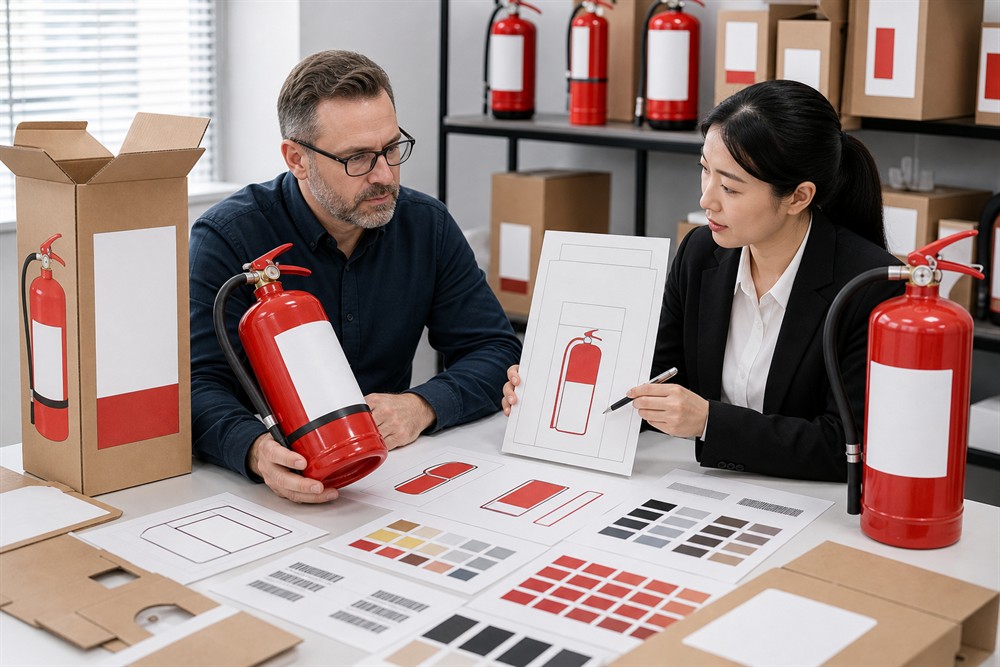
Review a physical sample for label size, curvature, adhesion, color, legibility, barcode scan quality, hose and gauge clearance, seam placement, and resistance to normal handling. Confirm that the label does not cover permanent cylinder markings or interfere with service inspection.
Also inspect the individual carton, manual, accessory placement, and master-pack arrangement. Keep signed golden samples and record the artwork revision.
Create a Production Control Pack
- Signed technical specification and approved bill of materials
- Model-specific compliance evidence
- Approved label, manual, barcode, and carton artwork
- Color references and print tolerances
- Golden sample photographs and physical samples
- Inspection checklist and sampling plan
- Packaging and container-loading specification
- Change-control and deviation-approval process
Inspect More Than the Logo
Pre-shipment inspection should verify quantity, model, agent charge, pressure or weight condition, components, function, finish, markings, traceability, carton information, accessories, and packing. Artwork checks are important, but they do not replace product inspection.
For early orders, consider reviewing production records and test evidence in addition to finished-goods sampling.
Plan Repeat Orders and Revisions
Store editable artwork, approved PDFs, revision history, translations, barcodes, and model mapping in a controlled location. When regulations, importer details, products, or packaging change, identify affected inventory and the implementation date.
Ask the factory to notify the buyer before changing controlled components or processes. A component substitution can affect compliance even if the label remains unchanged.
Support the Product After Delivery
Define warranty handling, spare parts, service information, complaint records, and batch traceability. A private label is a long-term promise to the market, so local service capability should be part of product planning.
A compliant private-label line connects brand design to a verified technical product and a repeatable manufacturing process. Treating artwork, specifications, testing, and change control as one system protects both the distributor and the end user.