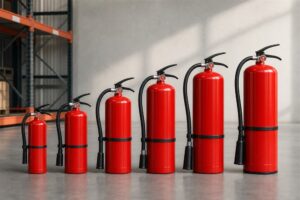
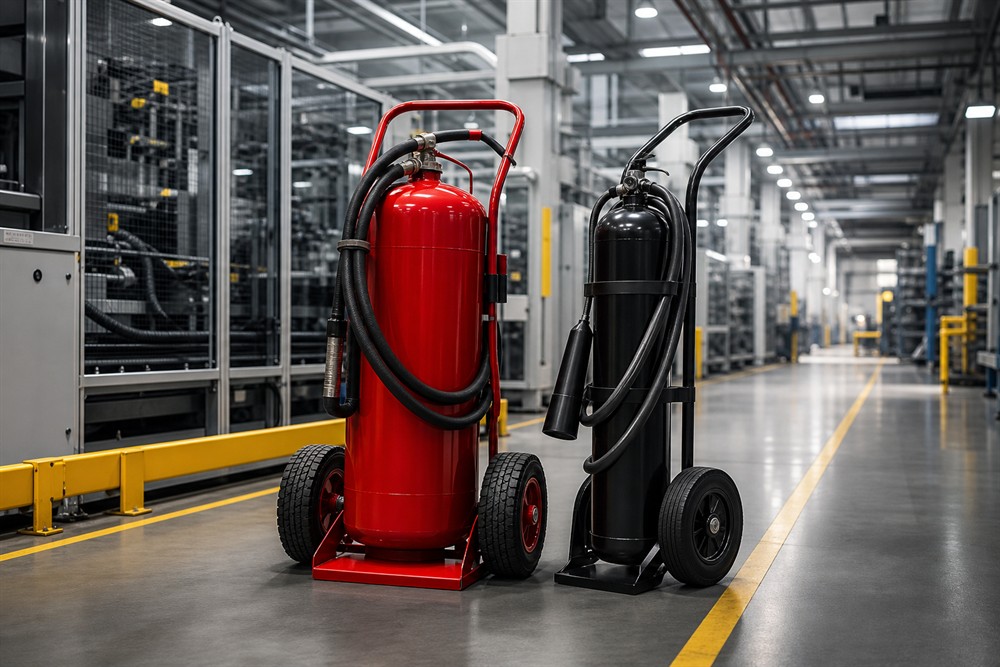
Wheeled fire extinguishers provide a larger agent supply and extended hose reach for hazards that may exceed the practical capability of a portable unit. They are commonly considered for industrial processing, fuel storage, aircraft service areas, warehouses, utilities, marine facilities, and other high-risk locations.
They require more than choosing a cylinder capacity. Mobility, operator access, hose performance, environmental exposure, maintenance, and local code requirements all influence suitability.
When a Wheeled Unit May Be Appropriate
A wheeled extinguisher may be selected where a larger fire rating, longer discharge, greater agent quantity, or more stand-off distance is needed. It can supplement fixed systems and portable extinguishers but should not be assumed to replace either.
The hazard assessment should consider fuel type, possible fire size, response time, trained personnel, travel distance, obstacles, and whether one operator can position and use the equipment safely.
Common Agent Configurations
Dry chemical
Wheeled dry chemical units are used for various flammable-liquid, gas, and mixed industrial hazards depending on the powder and rating. They offer strong knockdown performance but produce residue and may reduce visibility.
CO2
Wheeled CO2 extinguishers provide a residue-free discharge for selected electrical and flammable-liquid risks. The cylinders are heavy, and the gas can disperse in outdoor or ventilated areas. Confined-space safety requires particular attention.
Foam and other agents
Foam, water-based, wet chemical, or specialized agents may be used for defined hazards where approved. Temperature range, concentrate or premix specification, electrical limitations, and environmental rules must be verified.
Evaluate the Trolley as Safety Equipment
The frame, axle, wheels, handle, cylinder restraint, balance, ground clearance, and parking stability determine whether the unit can be moved under real site conditions. A showroom trolley may perform poorly on ramps, joints, gravel, thresholds, or contaminated floors.
- Confirm wheel diameter, material, bearings, and load rating
- Check handle height and pushing or pulling ergonomics
- Evaluate stability during storage, movement, and hose deployment
- Verify corrosion protection for indoor, outdoor, marine, or chemical exposure
- Confirm cylinder retention and protection from impact
Specify the Hose and Discharge Assembly
Hose length should provide access without creating excessive pressure loss, handling difficulty, or storage problems. Confirm pressure rating, internal diameter, flexibility, fittings, reel or storage method, nozzle or horn, shut-off control, and replacement availability.
Some units require a defined operating sequence involving a cylinder valve, propellant source, hose, and applicator. Instructions should be clear and training should reflect the exact model.
Check Performance and Documentation
Request the applicable test, approval, or rating evidence for the exact agent quantity, cylinder, trolley, hose, and nozzle configuration. Confirm discharge time, effective range where specified, operating temperature, filled weight, dimensions, and service requirements.
For project procurement, include drawings and storage clearances so the unit fits the designated location and can be removed without obstruction.
Plan Inspection and Maintenance
Wheeled units contain more hardware and stored agent than portable extinguishers. Inspection should cover pressure or weight condition as applicable, seals, hose, nozzle, wheels, frame, corrosion, instructions, accessibility, and service date. Maintenance must follow the manufacturer’s instructions and local regulations.
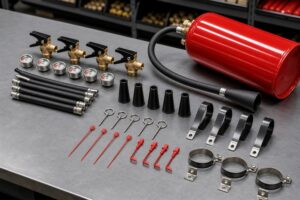
Ask the supplier for recommended spare parts such as hoses, applicators, seals, wheels, gauges, valves, and service kits. Large or specialized components may have longer lead times.
Information to Put in the Purchase Specification
- Hazard, agent, nominal charge, and required rating
- Applicable standard and destination-market documentation
- Cylinder construction and operating temperature
- Trolley dimensions, filled weight, wheels, and finish
- Hose length, pressure rating, and applicator type
- Instructions, markings, cover, packaging, and spare parts
- Inspection, test, and traceability records
Wheeled extinguishers are effective when their capacity, mobility, and discharge system match a defined industrial risk. A complete specification prevents the purchase from becoming a simple comparison of cylinder size and price.