ABC dry powder and carbon dioxide extinguishers are two of the most widely purchased categories in commercial fire protection. They are not interchangeable, however. Each has different fire-class coverage, discharge behavior, maintenance needs, handling characteristics, and landed-cost implications.
For B2B buyers, the correct decision starts with the protected risk and local requirements, not with the most familiar cylinder size.
How ABC Dry Powder Extinguishers Work
ABC dry chemical extinguishers use a powder formulated to interrupt the combustion process and, on Class A materials, help separate the fuel from oxygen. Depending on the applicable standard and rating, they are commonly selected for ordinary combustibles, flammable liquids, and flammable gases.
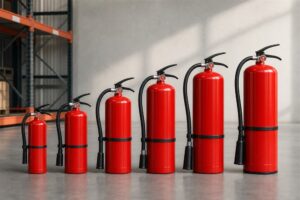
Their broad coverage makes them practical for warehouses, workshops, vehicles, mixed commercial spaces, construction sites, and general industrial applications. They are available in compact portable models as well as larger portable and wheeled configurations.
Key advantages
- Broad fire-class coverage for many mixed-risk environments
- Wide range of capacities and discharge configurations
- Strong knockdown performance when correctly specified
- Generally familiar to installers, distributors, and service companies
Important limitations
Dry powder creates residue and can impair visibility in confined spaces. Cleanup may be significant, and powder can affect sensitive equipment. Buyers should also pay attention to powder quality, moisture resistance, compaction behavior, filling accuracy, and compatibility with valves and discharge assemblies.
How CO2 Extinguishers Work
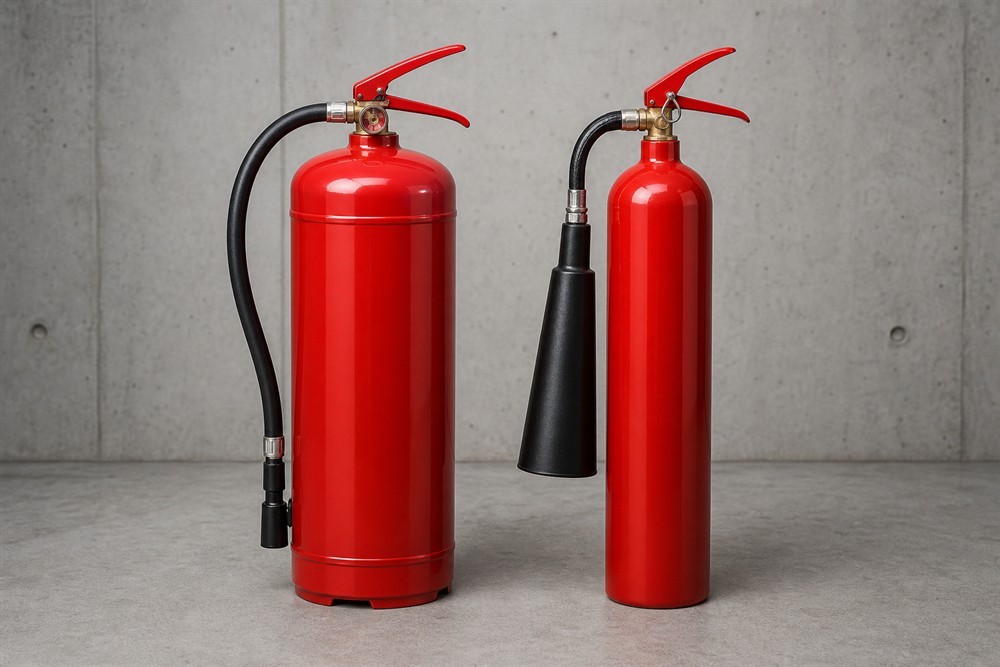
CO2 extinguishers discharge carbon dioxide gas, reducing the oxygen available around the flame and providing a cooling effect through expansion. They leave no powder or foam residue, which is useful around electrical equipment, control rooms, laboratories, and selected flammable-liquid risks.
CO2 does not provide the same general-purpose Class A protection as an ABC dry powder unit. The gas can also disperse quickly outdoors or in strongly ventilated areas, increasing the possibility of re-ignition if the fuel remains hot.
Key advantages
- No extinguishing-agent residue after discharge
- Useful for energized electrical equipment when selected according to local rules
- Clear identification through its characteristic discharge horn
- Suitable for environments where cleanup could damage equipment or processes
Important limitations
CO2 cylinders are typically heavier for their apparent size because the agent is stored under high pressure. The horn and discharge assembly require careful design, and users must avoid cold-burn hazards during operation. CO2 also creates an asphyxiation risk in confined spaces, so placement and user training matter.
Compare the Total Procurement Specification
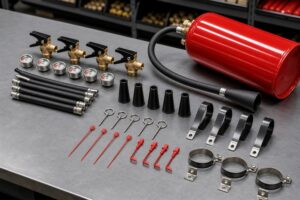
Price comparisons should use equivalent specifications. For dry powder models, confirm agent grade and percentage, nominal charge, propellant arrangement, fire rating, operating temperature, hose length, gauge, and valve. For CO2 models, confirm cylinder construction, filling ratio, valve, horn, hose where applicable, burst-disc arrangement, weight tolerances, and required markings.
Also compare brackets, wall hooks, cartons, manuals, labels, spare parts, pallet quantities, and container loading. A lower unit price may be offset by higher freight, replacement parts, or service complexity.
Choose by Risk, Not by Habit
ABC dry powder is often appropriate where multiple common fire classes are present and residue is an acceptable trade-off. CO2 is often preferred around electrical or sensitive equipment where a clean discharge matters. Many facilities use both types in different locations rather than selecting one extinguisher for the entire site.
The final selection and quantity should follow the destination market’s fire code, hazard assessment, installation rules, and approval requirements. A manufacturer can provide product data and configuration options, but the local fire protection designer or authority determines suitability for a specific project.
Questions to Send With Your RFQ
- Which fire classes and ratings apply to the offered model?
- Which approval or test documentation matches the exact configuration?
- What agent specification, fill tolerance, and operating range are used?
- What accessories and brackets are included?
- What are the net weight, gross weight, carton dimensions, and loading quantity?
- Which spare parts should be ordered for local servicing?
A clear comparison based on risk, compliance, serviceability, and logistics will produce a better purchasing decision than comparing capacity and price alone.